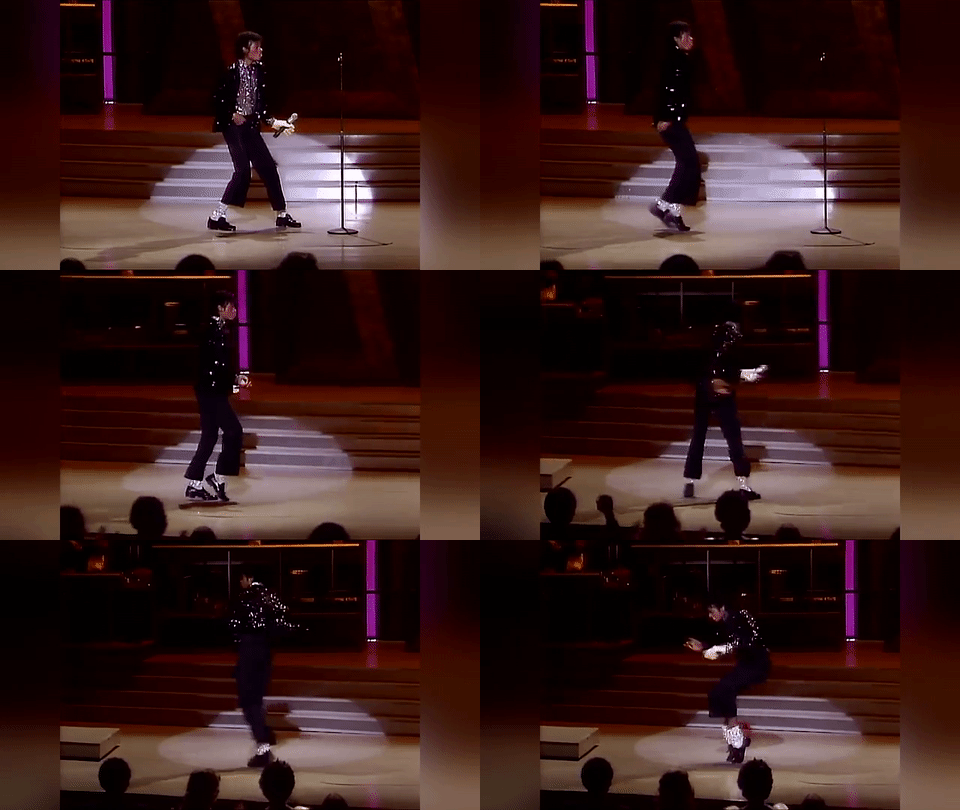
Performance & Participation-
Theatrical dance, also called performance or concert dance, is intended primarily as a spectacle, usually a performance upon a stageby virtuoso dancers. It often tells a story, perhaps using mime, costumeand scenery, or else it may simply interpret the musical accompaniment, which is often specially composed. Examples are western ballet andmodern dance, Classical Indian dance and Chinese and Japanese song and dance dramas. Most classical forms are centred upon dance alone, but performance dance may also appear in opera and other forms ofmusical theatre.
Participatory dance, on the other hand, whether it be a folk dance, asocial dance, a group dance such as a line, circle, chain or square dance, or a partner dance such as is common in western Western ballroom dancing, is undertaken primarily for a common purpose, such as social interaction or exercise, of participants rather than onlookers. Such dance seldom has any narrative. A group dance and a corps de ballet, a social partner dance and a pas de deux, differ profoundly. Even a solo dance may be undertaken solely for the satisfaction of the dancer. Participatory dancers often all employ the same movements and steps but, for example, in the rave culture of electronic dance music, vast crowds may engage in free dance, uncoordinated with those around them. On the other hand, some cultures lay down strict rules as to the particular dances in which, for example, men, women and children may or must participate.
Origin-
Archeological evidence for early dance includes 9,000-year-old paintings in India at the Rock Shelters of Bhimbetka, and Egyptian tomb paintings depicting dancing figures, dated c. 3300 BC. It has been proposed that before the invention of written languages, dance was an important part of the oral and performance methods of passing stories down from generation to generation. The use of dance in ecstatictrance states and healing rituals (as observed today in many contemporary "primitive" cultures, from the Brazilian rainforest to the Kalahari Desert) is thought to have been another early factor in the social development of dance.References to dance can be found in very early recorded history; Greek dance (horos) is referred to by Plato, Aristotle, Plutarch andLucian. The Bible and Talmud refer to many events related to dance, and contain over 30 different dance terms. In Chinese pottery as early as the Neolithic period, groups of people are depicted dancing in a line holding hands, and the earliest Chinese word for "dance" is found written in the oracle bones. Dance is further described in the Lüshi Chunqiu. Primitive dance in ancient China was associated with sorcery and shamanic rituals.
During the first millennium BCE in India, many texts were composed which attempted to codify aspects of daily life. Bharata Muni's Natyashastra (literally "the text of dramaturgy") is one of the earlier texts. It mainly deals with drama, in which dance plays an important part in Indian culture. It categorizes dance into four types - secular, ritual, abstract, and, interpretive - and into four regional varieties. The text elaborates various hand-gestures (mudras) and classifies movements of the various limbs, steps and so on. A strong continuous tradition of dance has since continued in India, through to modern times, where it continues to play a role in culture, ritual, and, notably, the Bollywood entertainment industry. Many other contemporary dance forms can likewise be traced back to historical, traditional, ceremonial, and ethnic dance.

History-
People have always danced. Every society has its own dances. There are pictures, on pottery and stone, which show dances from several thousand years ago, in Egypt and Greece.
Sachs divides early dances into 'Imageless dances' and 'Image dances'. By 'imageless dances' he meant dances which have no set form, but aim at getting the dancers into a state of ecstasy. In this state the dancer(s) seem changed, in a trance, and are often thought of (by their society) as being 'possessed by spirits'. These dances are done on certain occasions: marriage, war, famine, illness or death, and so on. They are found in all early ('primitive') societies.
The 'image dances', according to Sachs, are to do with the world outside the dancer. By imitating an animal or object, the dancer believes he can capture a power and make it useful. To dance in imitation of the animal which is going to be hunted is to become one with them. This is the kind of thinking behind an image dance. Sachs points out that societies of this kind do not really understand the connection between cause and effect. They really believe the image dances work. The dance type which is used in image dances is mime.
The two styles of dance may be joined together. Fertility dances may involve both ecstatic states and mime. The great dancer Nijinsky used some of these ideas in his choreography for the ballet Le Sacre du Printemps (The Rite of Spring), a ballet about the sacrifice of a girl during a primitive celebration of Spring.
Coming to more recent times, the first dance school we know about was opened in 1661 in Paris. Only men were accepted until 1681. After 1681, women were accepted too. Ballroom dances are forms of modern dance. Ballroom dances such as the waltz are done by couples.
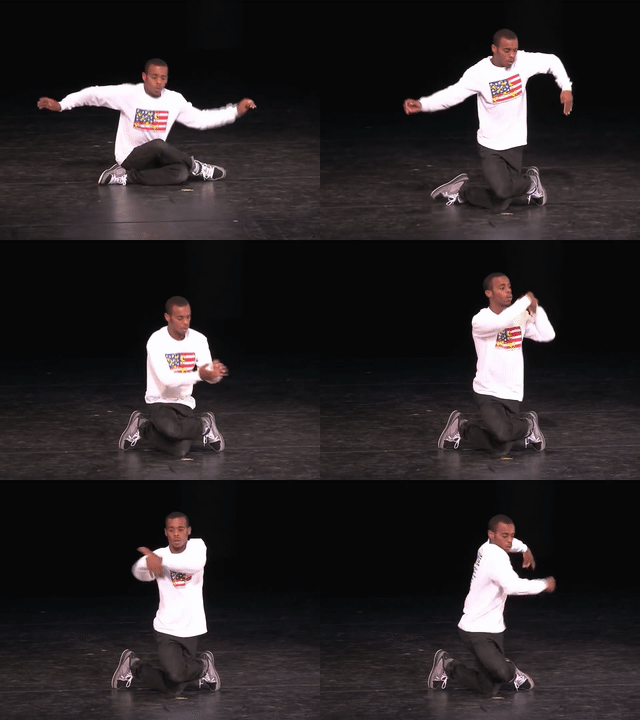
Until the 20th century, most ballroom dances were sequence dances. The way people moved was planned in set formation. These formations were usually lines or squares. Everyone moved at the same time, and finished at the same time. The music played for a set time, and then stopped. After the invention of the waltz, around 1800, another style of dancing developed. In the waltz, and later dances, people danced in couples, but they did so separately. They did not dance in formation, but moved round the room as they pleased (but anti-clockwise). Often, new dance styles arrive. Some dance as individuals, separately, as they please.Street dance is like that. All these types of dance have music.
At the same time, round the world there are many traditional dances. Some of them have been going for hundreds of years. We call them folkloric dances.
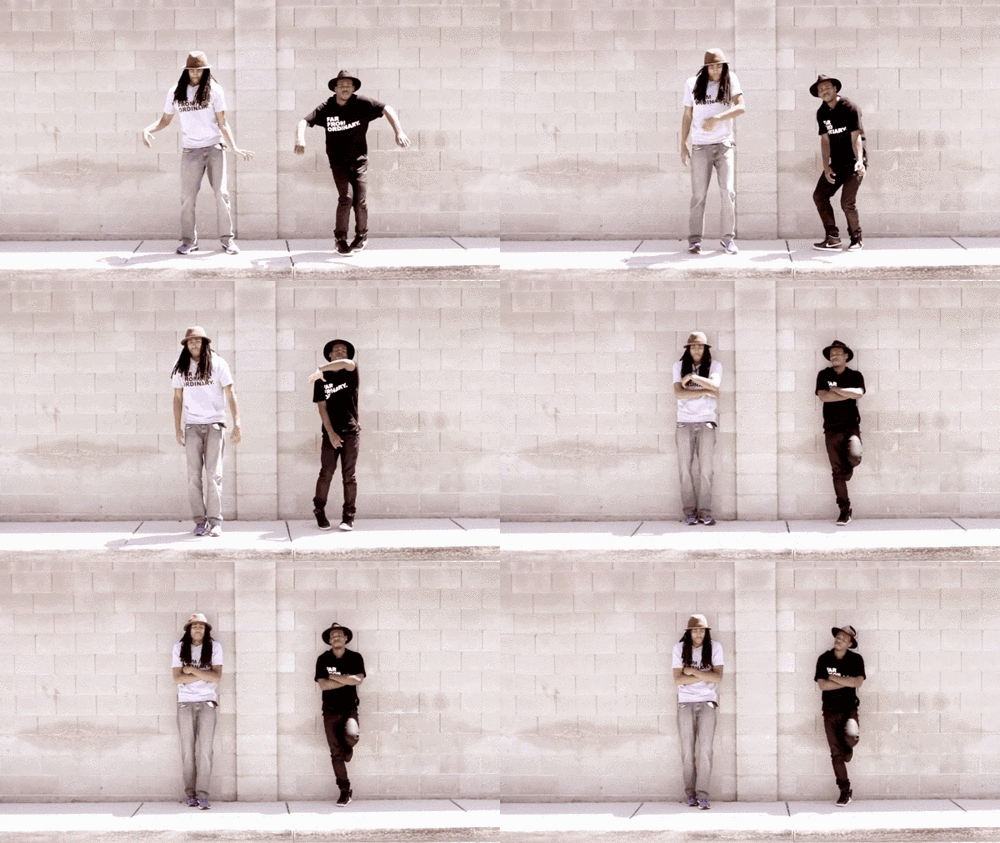
The coming of popular music videos and DVDs led to a kind of dancer previously seen in some stage shows. A backup dancer (or background dancer) is a performer who dances with or behind the lead performers in a live musical act or in a music video.
Dancing & Music-
Dance is generally, though not exclusively, performed with the accompaniment of music and may or may not be performed intime to such music. Some dance (such as tap dance) may provide its own audible accompaniment in place of (or in addition to) music. Many early forms of music and dance were created for each other and are frequently performed together. Notable examples of traditional dance/music couplings include the jig, waltz, tango, disco, and salsa. Some musical genres have a parallel dance form such as baroque music and baroque dance; other varieties of dance and music may share nomenclature but developed separately, such as classical music and classical ballet.
Dance music is music composed specifically to facilitate or accompany dancing. It can be either a whole musical piece or part of a larger musical arrangement. In terms of performance, the major categories are live dance music and recorded dance music. While there exist attestations of the combination of dance and music in ancient times (for example Ancient Greek vases sometimes show dancers accompanied by musicians), the earliest Western dance music that we can still reproduce with a degree of certainty are the surviving medieval dances. In the Baroque period, the major dance styles werenoble court dances (see Baroque dance). In the classical music era, the minuet was frequently used as a third movement, although in this context it would not accompany any dancing. The waltz also arose later in the classical era. Both remained part of the romantic music period, which also saw the rise of various other nationalistic dance forms like the barcarolle,mazurka,ecossaise,ballade and polonaise.
Modern popular dance music initially emerged from late 19th century's Western ballroom and social dance music. During the early 20th century, ballroom dancing gained popularity among the working class who attended public dance halls. Dance music became enormously popular during the 1920s. In the 1930s, called the Swing era, Swing music was the popular dance music. In the 1950s, rock and roll became the popular dance music. The late 1960s saw the rise of soul and R&Bmusic. The rise of disco in the early 1970s led to dance music becoming popular with the public. By the late 1970s,electronic dance music was developing. This music, made using electronics, is a style of popular music commonly played in dance music nightclubs, radio stations, shows and raves. Many subgenres of electronic dance music have evolved.
Asia-
All Indian classical dances are to varying degrees rooted in the Natyashastra and therefore share common features: for example, the mudras (hand positions), some body positions, and the inclusion of dramatic or expressive acting or abhinaya. Indian classical music provides accompaniment and dancers of nearly all the styles wear bells around their ankles to counterpoint and complement the percussion.
There are now many regional varieties of Indian classical dance. Dances like "Odra Magadhi", which after decades long debate, has been traced to present day Mithila,Odisha region's dance form of Odissi (Orissi), indicate influence of dances in cultural interactions between different regions.
The Punjab area overlapping India and Pakistan is the place of origin of Bhangra. It is widely known both as a style of music and a dance. It is mostly related to ancient harvest celebrations, love, patriotism or social issues. Its music is coordinated by a musical instrument called the 'Dhol'. Bhangra is not just music but a dance, a celebration of the harvest where people beat the dhol (drum), sing Boliyaan (lyrics) and dance. It developed further with the Vaisakhi festival of the Sikhs.
The dances of Sri Lanka include the devil dances (yakun natima), a carefully crafted ritual reaching far back into Sri Lanka's pre-Buddhist past that combines ancient "Ayurvedic" concepts of disease causation with psychological manipulation and combines many aspects including Sinhalese cosmology. Their influence can be seen on the classical dances of Sri Lanka.
The dances of the Middle East are usually the traditional forms of circle dancingwhich are modernized to an extent. They would include dabke, tamzara, Assyrian folk dance, Kurdish dance, Armenian dance and Turkish dance, among others.All these forms of dances would usually involve participants engaging each other by holding hands or arms (depending on the style of the dance). They would make rhythmic moves with their legs and shoulders as they curve around the dance floor. The head of the dance would generally hold a cane or handkerchief.
Dance in Films-
Dance and song sequences have been an integral component of films across the country. With the introduction of sound to cinema in the film Alam Ara in 1931, choreographed dance sequences became ubiquitous in Hindi and other Indian films.[ Dance in early Hindi films was primarily modelled on classical Indian dance styles and particularly those of historic North Indian courtesans (tawaif), or folk dancers. Modern films often blend this earlier style with Western dance styles (MTV or inBroadway musicals), though it is not unusual to see western choreography and adapted classical dance numbers side by side in the same film. Typically, the hero or heroine performs with a troupe of supporting dancers. Many song-and-dance routines in Indian films feature dramatic shifts of location and/or changes of costume between verses of a song. It is popular for a hero and heroine to dance and sing apas de deux (a French ballet term, meaning "dance of two") in beautiful natural surroundings or architecturally grand settings, referred to as a "picturisation".Indian films have often used what are now called "item numbers" where a glamorous female figure performs a cameo. The choreography for such item numbers varies depending on the film's genre and situation. The film actress and dancer Helen was famous for her cabaret numbers. The influence of the dance sequences of films on popular culture is significant, with amateur dancers often copying such dancing moves during celebratory events and performances, such as during wedding parties or other urbanized festivals.
Often in movies, the actors don't sing the songs themselves that they dance too, but have another artist sing in the background. For an actor to sing in the song is unlikely but not rare. The dances in Bollywood can range from slow dancing, to a more upbeat hip hop style dance. The dancing itself is a fusion of all dance forms. It could be Indian classical, Indian folk dance, belly dancing, jazz, hip hop and everything else you can imagine.